The Illusionist unfolds quietly, with patience and restraint. It does not rush to impress. Instead, it draws you into a world where appearances matter more than truth, and where what you believe often shapes what you see.
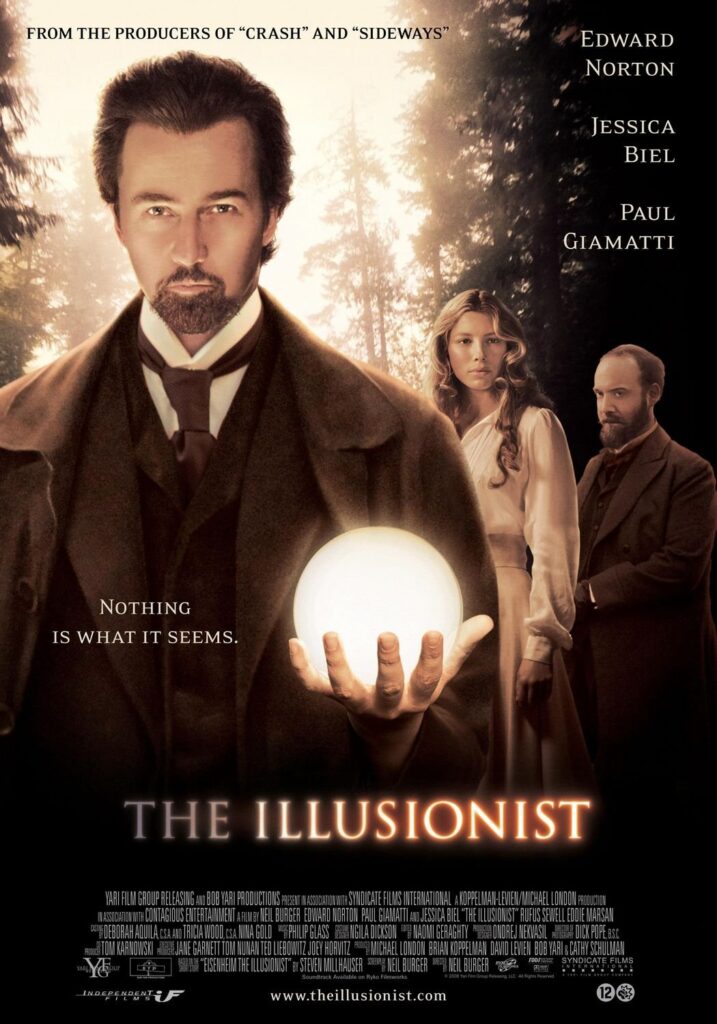
Released in 2006, the film feels deliberately old-fashioned in its rhythm. It trusts atmosphere over speed, mood over explanation. From the beginning, it asks the viewer to slow down and pay attention, not just to the tricks on screen, but to the emotions underneath them.
How the Film Feels
Watching The Illusionist feels like being invited into a dimly lit room where secrets are shared carefully. There is a softness to the film, but also a quiet tension that never fully disappears. The visuals carry a muted, almost dreamlike quality, making the world feel slightly removed from reality.
What stayed with me was the sense of longing that runs through the film. Beneath the mystery and spectacle, there is a deep sadness. The film does not push this emotion loudly. It allows it to surface slowly, trusting the viewer to feel it.
The Story in Brief
Set in early twentieth-century Vienna, the story follows Eisenheim, a magician whose performances captivate the public and unsettle those in power. His life becomes complicated when he reunites with Sophie, a woman he loved in his youth and who is now engaged to a powerful crown prince.
As Eisenheim’s illusions grow more daring, they begin to blur the line between performance and reality. What appears to be a series of clever tricks gradually reveals itself as something more carefully planned. The story moves toward a revelation that forces the audience to reconsider everything they have seen.
The Hands Behind the Film
Director Neil Burger approaches the material with restraint. He avoids turning the film into a flashy display of tricks, instead focusing on mood and pacing. The choices feel intentional, allowing mystery to build without unnecessary spectacle.
The film’s visual design supports its themes. Shadows, candlelight, and subdued colors create an atmosphere where uncertainty feels natural. The craft serves the story quietly, never demanding attention for itself.
Characters and Performances
Edward Norton plays Eisenheim with calm intensity. His performance is measured, almost distant, which suits a character built on control and concealment. He never oversells emotion, allowing subtle gestures to carry meaning.
Jessica Biel brings warmth and vulnerability to Sophie, grounding the film’s emotional core. Paul Giamatti, as the inspector torn between logic and doubt, delivers a performance filled with internal conflict, making the struggle between reason and belief feel human and sincere.
Why It Resonates
The Illusionist stays with you because it understands that illusion is not just about deception. It is about hope, memory, and the desire to reshape reality when the world feels unjust.
The film suggests that belief can be a form of resistance. That sometimes, what we choose to see matters more than what is placed in front of us. When the final reveal settles in, what lingers is not the cleverness of the trick, but the quiet emotional truth beneath it.