The Haunting is built on a simple but radical idea:
The house is not a setting — it is the event.
Nothing in the film behaves like traditional horror. There is no visible monster, no clear explanation, no release through confrontation. Instead, the film asks a more uncomfortable question: what if a space itself could exert pressure, without intention or awareness?
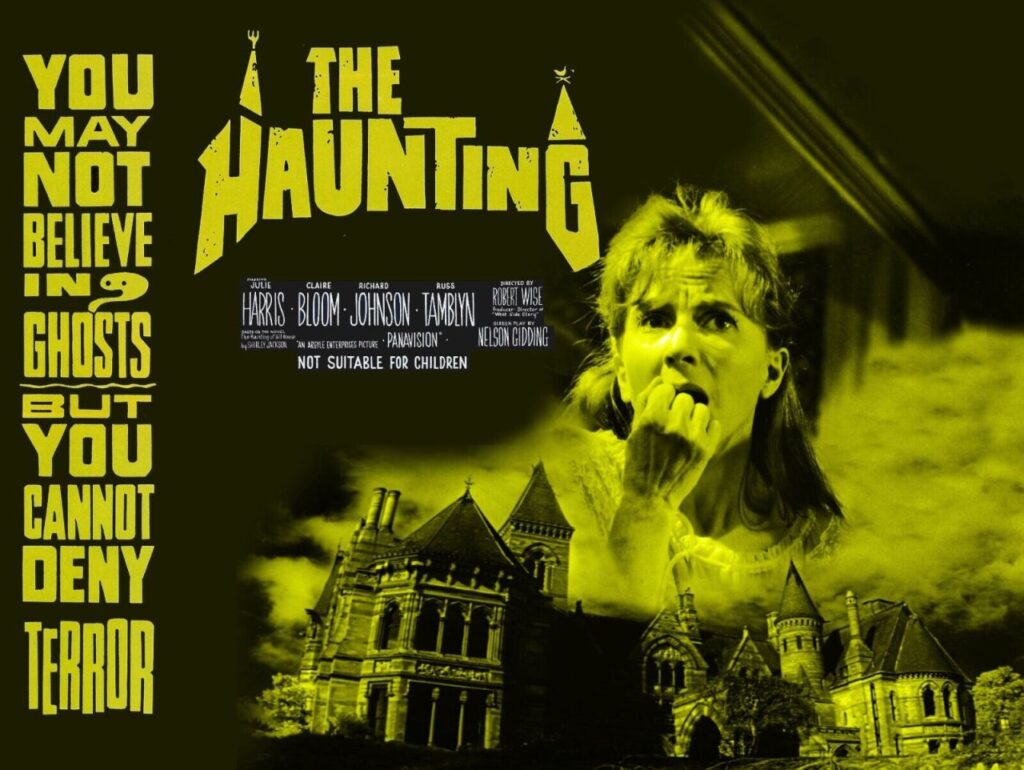
Released in 1963, The Haunting arrived before modern horror grammar had settled. Rather than inventing shocks, it removes certainty. The result is a film where fear does not arrive — it accumulates.
Like Psycho (1960), The Haunting understands that fear does not need to be seen to be effective – it only needs to be carefully positioned.
A Brief Review
The film works by denial. It denies the audience visual confirmation, denies narrative clarity, and denies emotional reassurance. Scenes linger longer than expected. Sounds arrive without sources. Rooms feel slightly off-balance.
What makes The Haunting effective is that it never tells the viewer what to fear. It places characters inside an environment that refuses neutrality. The discomfort comes not from what happens, but from where it happens.
The experience is oppressive rather than frightening — a sustained sense of being held in a place that does not want you.
Short Story Summary
A small group is invited to Hill House to investigate reports of paranormal activity. The house has a documented history of tragedy, but the film shows almost none of it directly.
One participant, emotionally isolated and searching for belonging, responds to the house differently. As nights pass, the environment begins to collapse boundaries — between inside and outside, between thought and sound, between imagination and experience.
Nothing definitive is revealed. Instead, the house absorbs emotion and reflects it back, unevenly and without explanation. The story unfolds as a gradual loss of emotional footing rather than a mystery to be solved.
The Hands Behind the Film
Director Robert Wise structures the film around restraint. His control lies in refusing spectacle, allowing time and repetition to create unease. Wise does not direct attention — he withdraws it.
Cinematography by Davis Boulton is central to the film’s effect. Wide-angle lenses bend walls and ceilings, making rooms feel subtly hostile. The camera often frames characters as intrusions into space rather than occupants of it.
Sound design is the film’s most aggressive tool. Off-screen pounding, echoes, and reverberations replace visual threats. Sound becomes the mechanism through which the house asserts itself, forcing the audience to imagine what the frame withholds.
This combination turns architecture into pressure.
Characters and Emotional Exposure
The central character, played by Julie Harris, is not brave or curious in a conventional sense. She is emotionally porous. Her openness to connection makes her more responsive to the house — and more vulnerable to it.
Other characters function as emotional contrasts: sceptical, analytical, guarded. The house does not respond to them equally. Sensitivity, rather than belief, determines impact.
Fear in this film is selective.
Why It Endures
The Haunting endures because it refuses resolution.
It proposes that:
- Spaces can hold emotional weight without consciousness
- Architecture can destabilise without violence
- Fear does not need a source to be real
The film never explains Hill House, and that refusal is its strength. By denying clarity, it allows unease to persist beyond the frame.
More than sixty years later, The Haunting remains disturbing because it treats fear as an environmental condition — something you step into and may not step out of unchanged.
That idea has not aged.