Rear Window begins with stillness. A man sits, unable to move, surrounded by heat and boredom. The world comes to him through windows, fragments of other lives unfolding without context or permission.
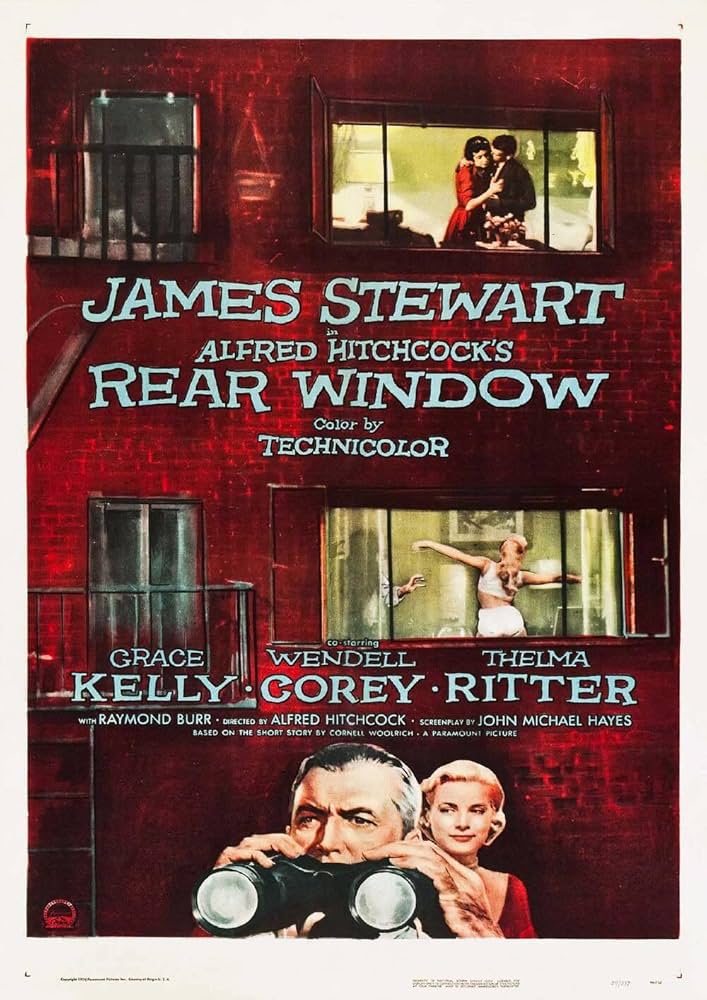
Released in 1954, the film feels confident in its simplicity. It places you in one position and asks you to stay there. There is no escape from watching, and no comfort in distance.
While Watching
Watching Rear Window is strangely absorbing. You start as an observer, curious but detached. Slowly, curiosity turns into involvement. You notice patterns. You form opinions. You begin to assume you understand what you are seeing.
I found myself becoming uneasy not because of what might be happening across the courtyard, but because of how willingly I was judging strangers from afar. The film quietly turns the gaze back on you.
The Story in Brief
The film follows Jeff, a photographer confined to his apartment with a broken leg. With nothing else to do, he begins watching his neighbors through their windows.
Over time, Jeff becomes convinced that one of them has committed a murder. With the help of his girlfriend Lisa and his nurse Stella, he tries to piece together clues from a distance, risking safety and trust as suspicion grows.
The Hands Behind the Film
Director Alfred Hitchcock builds the entire film around perspective. The camera rarely leaves Jeff’s apartment, forcing the audience to see only what he sees. This limitation creates tension without relying on spectacle.
The set design functions like a living organism. Every window tells a small story, adding texture and distraction while slowly feeding the central mystery.
Characters and Performances
James Stewart brings quiet frustration and moral ambiguity to Jeff. His performance balances charm with obsession, making his certainty feel both convincing and troubling.
Grace Kelly adds movement and clarity. Her presence shifts the film from passive observation to action. Thelma Ritter grounds the story with skepticism and sharp humor, cutting through assumption with common sense.
What It Leaves Behind
Rear Window stays because it asks an uncomfortable question without raising its voice. How much do we think we know just by watching? And how easily does curiosity slide into judgment?
The film leaves you aware of your own gaze. Of how watching can feel harmless, even justified, until it isn’t. When the screen goes dark, that awareness lingers, quietly unsettling, reminding you that looking is never as innocent as it feels.