Mayabazar (1957) is a timeless Telugu classic that blends wit, love, and dharma through memorable characters, humour, and gentle wisdom.
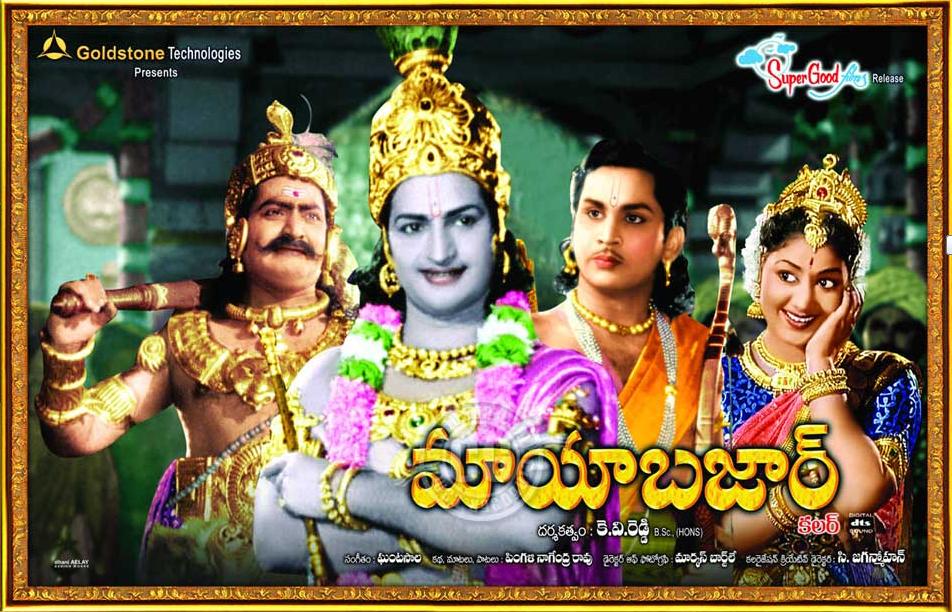
A Brief Review
Mayabazar is warm, witty, and effortlessly engaging. It never rushes its storytelling, allowing characters and situations to breathe. Comedy flows organically from intelligence rather than exaggeration, and emotion arises without melodrama.
The film respects its audience.
It trusts them to follow, to feel, and to reflect.
This is not a loud film.
It is a confident one.
Short Story Summary
Set during the events surrounding the Mahabharata, the story focuses on Abhimanyu and Sasirekha, whose love is threatened by political manipulation and broken promises. When circumstances turn against them, divine intervention arrives in an unexpected form.
Ghatotkacha, known for his strength and magical abilities, steps in, not merely as a warrior, but as a strategist who uses wit, illusion, and intelligence to restore justice.
The story unfolds as a clever contest between deceit and wisdom, where victory is achieved not through violence, but through understanding human weakness.
The Hands Behind the Film
Directed by K. V. Reddy, Mayabazar displays remarkable narrative control. The direction never overwhelms the story with spectacle. Instead, it lets humour, dialogue, and timing carry the film forward.
The music, composed by Ghantasala, is woven seamlessly into the narrative. Songs emerge naturally from emotion and situation, enhancing the film without interrupting its flow. The music remains memorable because it serves the story, not because it seeks attention.
The visual presentation, though created with limited technology, relies on imagination rather than realism , a choice that gives the film its timeless charm.
Characters and Emotional Balance
Ghatotkacha, portrayed by S. V. Ranga Rao, is the heart of the film. His performance blends strength with empathy, intelligence with playfulness. He is powerful, yet deeply human.
Sasirekha, played by Savitri, is not a passive figure. She represents dignity, patience, and quiet resolve. Her presence grounds the story emotionally, reminding us that justice is not only about power, but about fairness.
Krishna, portrayed by N. T. Rama Rao, brings calm authority to the narrative. His guidance is subtle, reinforcing the idea that wisdom often works behind the scenes.
Why It Stays
Mayabazar stays relevant because its core values do not age.
It reminds us that:
- Intelligence can defeat manipulation
- Compassion can coexist with strength
- Justice does not always need force
The film does not preach morality.
It demonstrates it through humour, patience, and grace.
In an era where spectacle often overshadows substance, Mayabazar endures as proof that clarity of intent and respect for storytelling are enough to create something timeless.
That is why this film continues to be watched, quoted, and loved, not as history, but as living cinema.
Excellent
Pingback: Gone with the Wind (1939) : Love, Loss, and Survival Against Time - framesandfeelings.com