Gone with the Wind explores love, loss, and survival during a changing world, remaining one of cinema’s most emotionally enduring epics.
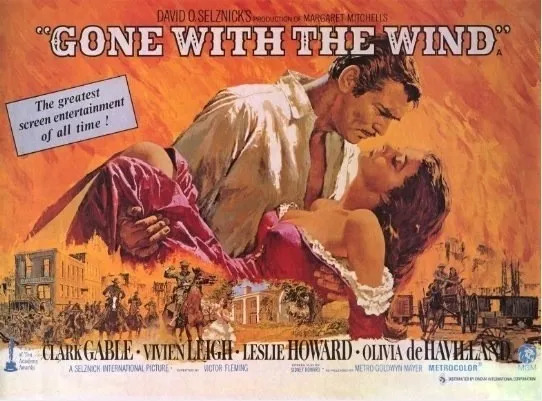
A Brief Review
Gone with the Wind is often remembered for its grandeur, sweeping landscapes, elaborate costumes, and a scale rarely seen in cinema. But beneath its spectacle lies a quieter, more enduring story about survival, desire, and the cost of holding on.
Released in 1939, the film remains a cultural landmark not simply because of its ambition, but because it captures emotional endurance during collapse , personal, social, and historical.
It is a film about things that refuse to disappear, even when the world changes beyond
Short Story Summary
Set against the backdrop of the American Civil War and its aftermath, the story follows Scarlett O’Hara, a woman driven by desire, pride, and an unyielding will to survive.
As the old world around her collapses, Scarlett clings to familiar emotions , love, resentment, ambition , even when they no longer serve her. Her relationship with Rhett Butler unfolds not as a conventional romance, but as a collision of two strong, conflicting temperaments shaped by loss.
The narrative is less about victory and more about endurance , what remains when comfort, certainty, and identity are stripped away.
The Hands Behind the Film
Directed primarily by Victor Fleming, the film balances intimacy with epic scale. The direction allows spectacle to exist without overwhelming character, ensuring emotional continuity amid historical chaos.
Based on the novel by Margaret Mitchell, the story carries a literary weight that shapes its structure and pacing. The film adapts this depth with restraint, letting character psychology guide the narrative rather than action alone.
The visual presentation emphasises contrast , beauty alongside destruction , reinforcing the film’s central tension between memory and change.
Characters and Emotional Weight
Scarlett O’Hara, portrayed by Vivien Leigh, is not designed to be admired easily. She is complex, flawed, and relentlessly self-preserving. Her strength lies not in morality, but in refusal to surrender.
Rhett Butler, played by Clark Gable, represents emotional honesty in a world built on illusion. His cynicism is not cruelty, but clarity , a recognition of what has already been lost.
Their relationship endures not because it is ideal, but because it is unresolved.
Why It Stays
Gone with the Wind endures because it refuses simplicity.
It reminds us that:
- Survival can come at emotional cost
- Change does not ask permission
- Letting go is often harder than loss
The film does not romanticise history.
It observes how people adapt ,or fail to , when familiar worlds vanish.
Long after its final moments, what remains is not spectacle, but a lingering question: what do we carry forward when everything else is gone?
That question is why Gone with the Wind continues to be discussed, revisited, and debated , not as nostalgia, but as enduring cinema like Mayabazar (1957) a Telugu language film.
Nice