Django Unchained reframes the western not as a story of frontier order, but as a confrontation with a history built on violence. The film does not seek neutrality. It announces its position early and never softens it: justice here is personal, and it is loud.
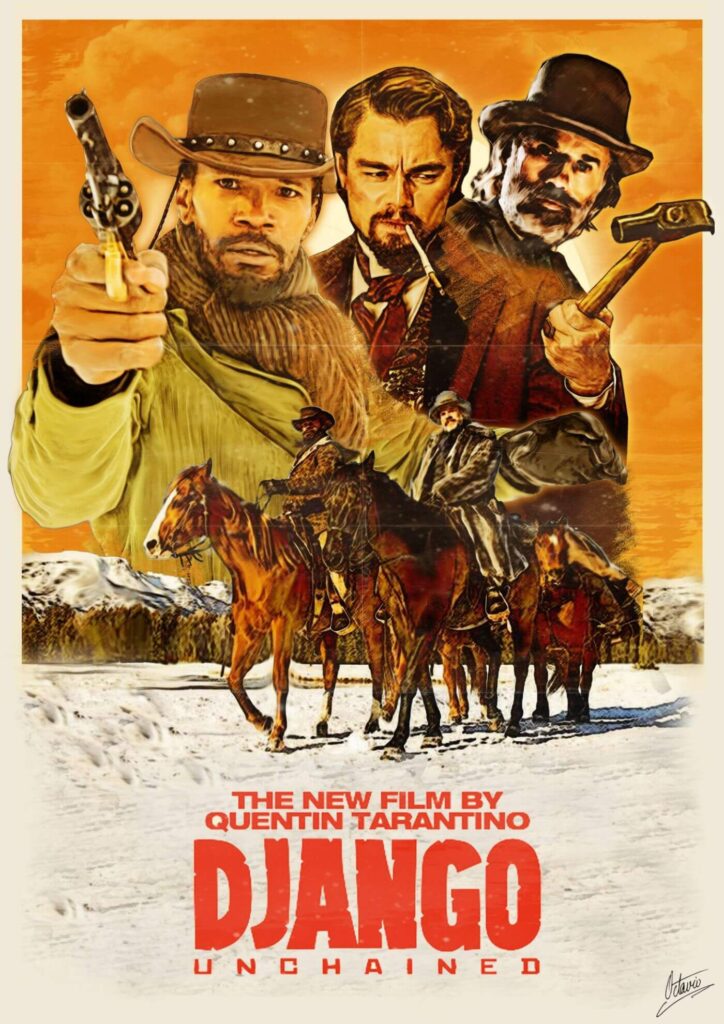
Released in 2012, the film arrived into a cultural moment already debating how cinema should approach historical cruelty. Instead of solemn distance, Django Unchained chooses confrontation, using genre exaggeration to force moral clarity rather than ambiguity.
This is not a film about freedom found.
It is a film about power reversed.
A Brief Review
The film moves with deliberate excess. Scenes stretch, conversations sharpen, and violence is framed not as chaos but as consequence. Humor is used strategically, not to trivialize suffering, but to puncture the false dignity of cruelty.
What distinguishes Django Unchained is its control over tone. It alternates between tension and release with precision, never allowing the audience to settle into comfort. The film’s bravado is calculated, not careless.
Short Story Summary
Set in the American South before the Civil War, the story follows an enslaved man liberated under unusual circumstances and drawn into a partnership that promises agency through skill and resolve. His objective is not abstract freedom, but the recovery of a person taken from him.
As the journey moves deeper into territories where violence is normalized, negotiation gives way to exposure. Civility becomes performance, and brutality hides behind ritual. The narrative builds toward an inevitable collision where restraint is no longer an option.
The story is linear, but the pressure is cumulative.
The Hands Behind the Film
Written and directed by Quentin Tarantino, the film is driven foremost by dialogue and structure. Tarantino uses language as a weapon and long scenes are designed to corner characters into revealing themselves before action arrives.
Music is central to the film’s identity. By mixing classic western cues with modern tracks, Tarantino collapses historical distance, refusing to let the past feel sealed or distant. Sound here is not period-correct; it is emotionally correct.
Cinematography emphasizes scale and contrast open landscapes against enclosed interiors, mirroring the shift from movement to entrapment as the story advances.
Characters and Power Dynamics
The central role, played by Jamie Foxx, evolves from quiet observation to deliberate assertion. The performance is controlled, allowing transformation to register through posture and decision rather than speech.
Opposite him, Christoph Waltz presents intelligence as both shield and liability, navigating violence through precision rather than force. His composure contrasts sharply with the volatility that surrounds him.
Leonardo DiCaprio embodies cruelty masked by charm, portraying entitlement as casual rather than theatrical. Samuel L. Jackson delivers a performance rooted in survival through alignment with power, complicating the film’s moral landscape.
Each character represents a different relationship to control.
Why It Endures
Django Unchained endures because it refuses distance.
It insists that:
- Violence tied to history cannot be neutralized by politeness
- Power reveals itself most clearly when threatened
- Revenge, in this context, is not indulgence but exposure
The film’s excess is intentional. By amplifying genre and tone, it prevents the audience from aestheticizing cruelty without consequence.
Years later, Django Unchained remains divisive and that division is part of its function. It does not ask to be agreed with. It asks to be confronted.