Jurassic Park is remembered for spectacle, but its staying power comes from something quieter , its caution about human confidence. Beneath the awe of resurrected dinosaurs lies a meditation on what happens when intelligence outruns humility.
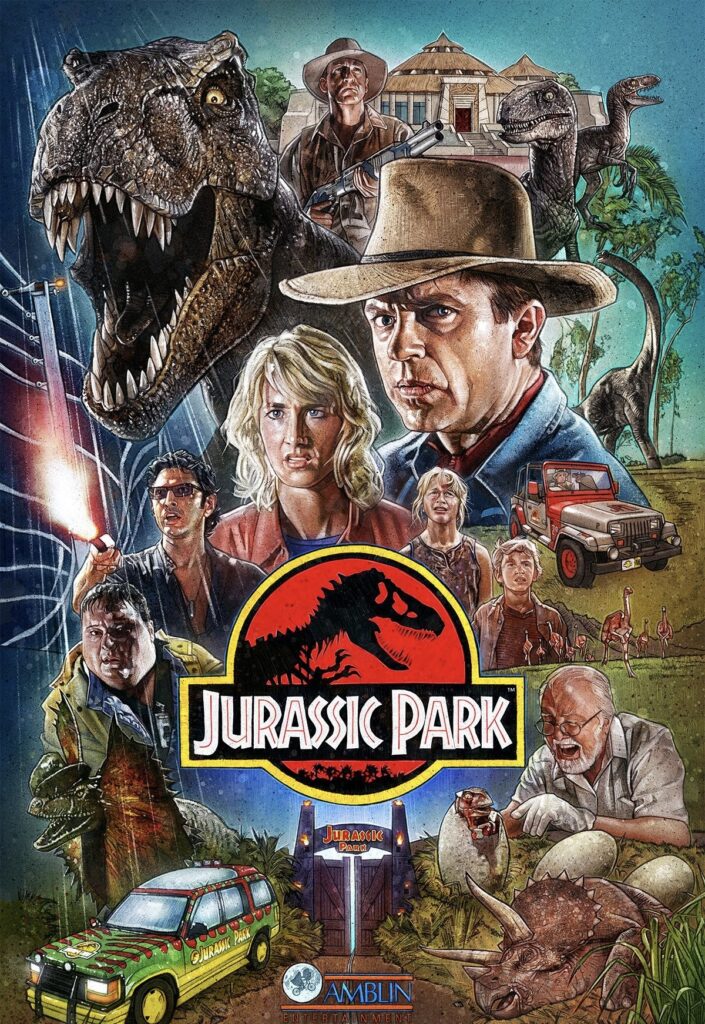
Released in 1993, the film arrived at a moment when technological optimism was high. Rather than celebrating mastery, it questioned it, asking whether capability alone is ever enough.
This is not just a film about dinosaurs.
It is a film about control , and its illusion.
A Brief Review
The film balances excitement with restraint. Moments of wonder are given time to breathe, allowing amazement to feel earned rather than imposed. Suspense grows not from constant threat, but from instability , the sense that systems built to contain nature are quietly failing.
What distinguishes Jurassic Park is its clarity. It never confuses scale with meaning, ensuring that every moment of spectacle carries consequence.
Short Story Summary
A group of scientists and experts are invited to preview a groundbreaking theme park where extinct creatures have been brought back through genetic science. What begins as a controlled demonstration quickly becomes fragile when nature, unpredictability, and human error intersect.
As safeguards collapse, survival depends less on authority and more on adaptability. The characters are forced to confront the reality that creation without restraint invites chaos rather than order.
The island becomes a closed system , one where ambition, curiosity, and fear collide.
The Hands Behind the Film
Directed by Steven Spielberg, Jurassic Park reflects a filmmaker deeply attuned to the balance between awe and restraint. Spielberg allows moments of discovery to unfold slowly, trusting silence and reaction as much as action.
The film’s emotional memory is inseparable from its music. Composed by John Williams, the score does not emphasise danger first, but wonder. Its central theme captures a childlike sense of discovery, reinforcing the idea that amazement precedes fear.
Rather than heightening suspense alone, the music frames the dinosaurs as magnificent and humbling , reminding the audience that what inspires awe also demands respect.
Characters and Human Perspective
The characters represent different responses to power , curiosity, caution, ambition, and responsibility. None are purely heroic or foolish. Each reacts according to belief rather than certainty.
What binds them is gradual recognition: that survival depends not on dominance, but on respect for forces beyond human design.
This human grounding keeps the film emotionally accessible despite its scale.
Why It Stays
Jurassic Park stays because its question remains unresolved.
It asks:
- Should we pursue what we can create, or what we can control?
- Does knowledge guarantee wisdom?
- Can nature ever be contained without consequence?
The film does not reject progress.
It challenges arrogance.
Decades later, Jurassic Park continues to resonate because its warning feels increasingly relevant , reminding us that awe and responsibility must evolve together.
That balance is why the film endures.