Rashomon is not a film that provides answers. Instead, it quietly dismantles the idea that truth is singular, stable, or easily known. What it offers is far more unsettling: the suggestion that truth bends with memory, ego, and fear.
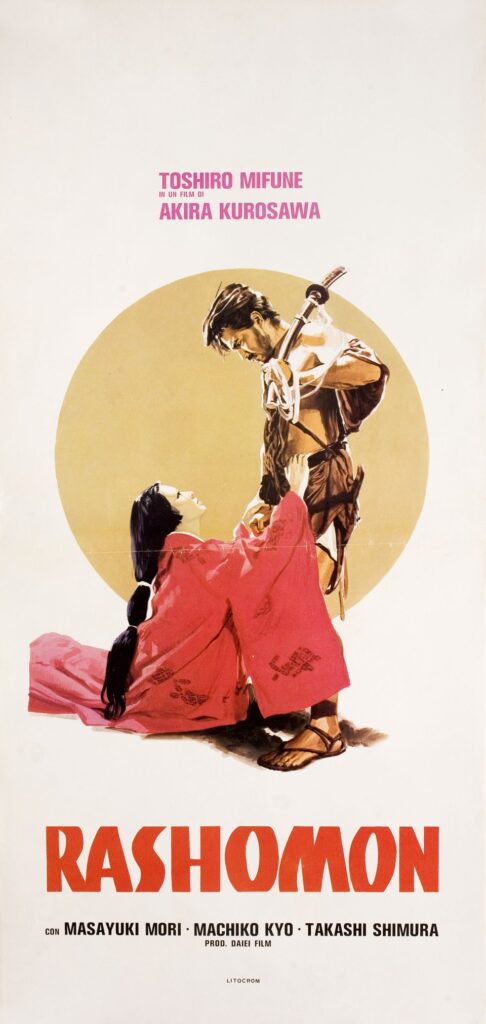
Released in 1950, Rashomon reshaped how cinema could think. Its influence lies not in technique alone, but in how deeply it questions human honesty — not as morality, but as instinct.
This is not a mystery to be solved.
It is a mirror held uncomfortably close.
A Brief Review
The film is restrained and spare. It avoids emotional cues and refuses to guide judgment. Instead, it presents perspectives with calm neutrality, allowing contradictions to stand unresolved.
Its power comes from repetition , the same event revisited, reshaped, reinterpreted. Each retelling feels sincere, yet none feel complete.
The film does not accuse.
It observes.
Short Story Summary
Set in feudal Japan, the story revolves around a violent crime , a murder and an assault , recounted through multiple testimonies. Each witness describes the same incident differently, with their own motivations, self-image, and emotional framing.
As the narratives unfold, certainty dissolves. Facts blur. Motives shift. What remains is not clarity, but discomfort , the realisation that every version of truth may be shaped by self-preservation.
The framing device, set beneath the ruined Rashomon gate, reinforces the moral collapse at the heart of the story , a world where trust feels fragile and meaning uncertain.
The Hands Behind the Film
Directed by Akira Kurosawa, Rashomon reflects a filmmaker deeply interested in human psychology rather than resolution. Kurosawa’s direction is precise, allowing form to serve inquiry rather than spectacle.
The film’s visual approach was groundbreaking, using light, shadow, and movement through nature to echo internal states. The forest is not just a setting , it becomes a space of moral ambiguity.
Music and pacing are restrained, ensuring that no perspective is emotionally privileged over another.
Characters and Moral Tension
Each character in Rashomon is less an individual than a position , a way of seeing oneself.
The accused, the victim, the witnesses , all speak with conviction. None are presented as villains or heroes. Their stories reveal less about the crime and more about the human need to appear justified.
Even the silent observer becomes complicit, reminding us that neutrality itself can be a choice shaped by fear or convenience.
Why It Stays
Rashomon stays because its question has never lost relevance.
It asks:
- Can truth exist without ego?
- Is honesty possible without self-interest?
- Do facts matter less than the stories we tell ourselves?
The film offers no resolution.
It offers awareness.
Long after the final testimony fades, what remains is uncertainty , not as weakness, but as insight. Rashomon endures because it teaches us to doubt not others alone, but ourselves.
That discomfort is its legacy.
Superb