Sholay is often spoken of as a landmark in Indian cinema, a film of iconic characters, unforgettable dialogue, and grand scale. But beneath its spectacle lies a simpler, more enduring idea: the power of loyalty in a world shaped by violence.
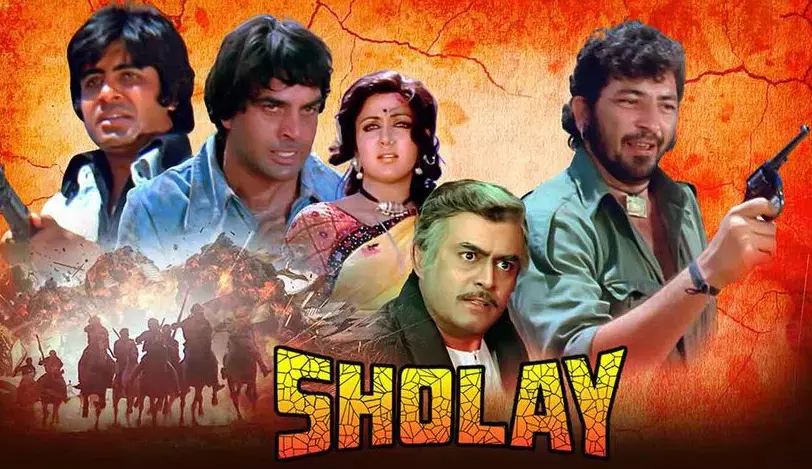
Released in 1975, Sholay blends action, drama, humour, and tragedy without losing emotional clarity. Its lasting impact comes not from scale alone, but from the relationships it carefully builds and tests.
Even decades later, the film feels less like a relic and more like a shared memory.
A Brief Review
Sholay is confident, patient, and emotionally balanced. It allows humour and danger to exist side by side, never letting one overpower the other. The film takes its time to establish bonds before placing them under pressure.
Its storytelling is deliberate.
Its emotions are earned.
This is not a film that rushes to impress.
It waits for its moments.
Short Story Summary
Set in the village of Ramgarh, the story follows Jai and Veeru, two small-time criminals hired by Thakur Baldev Singh to protect the village from the ruthless bandit Gabbar Singh.
As Jai and Veeru settle into village life, relationships form , not only between them, but with the people they are meant to protect. What begins as a contract slowly becomes responsibility.
The story unfolds as a confrontation between fear and conscience, where courage is measured not only in battle, but in sacrifice.
The Hands Behind the Film
Directed by Ramesh Sippy, Sholay maintains remarkable control over tone and pacing. The direction never allows scale to overpower emotion. Every action sequence exists to serve character and consequence.
The film’s visual language draws inspiration from westerns while remaining firmly rooted in Indian storytelling. Open landscapes and confined interiors reinforce the contrast between freedom and threat.
Music and background score support mood and memory without disrupting narrative flow, becoming part of how the film is remembered rather than merely heard.
Characters and Emotional Core
Jai, played by Amitabh Bachchan, is restrained and observant, choosing silence over display. His strength lies in judgment rather than impulse.
Veeru, portrayed by Dharmendra, is expressive and impulsive, guided by emotion more than logic. Together, they represent two halves of the same loyalty.
Thakur, played by Sanjeev Kumar, carries dignity shaped by loss, reminding us that justice often demands personal cost.
Gabbar Singh, portrayed by Amjad Khan, embodies fear through unpredictability rather than complexity.
Why It Stays
Sholay stays because its emotional foundation does not age.
It reminds us that:
- Friendship can be an act of resistance
- Courage often grows from connection
- Sacrifice gives meaning to loyalty
The film does not glorify violence.
It frames it as something that demands consequence.
Long after the dialogue fades, what remains is the bond between Jai and Veeru, a reminder that in uncertain worlds, standing together is often the bravest choice.
Nice
Pingback: Lagaan (2001) : How Unity Becomes an Act of Resistance - framesandfeelings.com